
What does inflation mean for investors and how does it affect financial assets? To illustrate this, we will use the example of an average (not sophisticated) investor who is interested in holding a traditional portfolio consisting of bonds and equities.
Due to economic and market conditions, an increase in inflation expectations will negatively affect bond prices, since the relationship between bond yields and bond prices, is inverse. This means that an increase in yields, due to an increase in interest rates, will decrease the price of the bond. For equities, an increase in inflation expectations, adds more pressure to P/E, price to earnings ratio, that tends to decline. There is a strong positive inverse correlation between inflation and P/E ratio.
That said, in both asset classes, herein stocks and bonds, the main argument against rising inflation, is that it technically erodes profitability, since the present value of future cash flows declines. In other words, having in mind that an investment is a lump sum payment of future cash flows, an increase in the discount rate is likely to lead to a decline of the future cash flow streams.
From a theoretical perspective, Gordon’s growth formula is mainly used by investors to determine the intrinsic value of a security based on future cash flows, in order to compare the predicted stock value against the actual market price. Interpreting the formula in terms of price to earnings (P/E ratio), the equation is equal to the inverse fraction of risk-free rate minus growth. Based on this, an increase in inflation will increase the risk-free rate, therefore the denominator, which tends to decrease the ratio.
Moreover, based on the constant growth dividend discount model, an increase in inflation will push prices up, reflected as an increase in nominal earnings. This framework assumes that inflation has no impact on equity valuations, since any increase in the price of the security will be equally reflected by an increase – of the same magnitude – in nominal earnings. As a result, the overall change will be constant, and inflation won’t be a problem. However, in the real economy this assumption doesn’t hold true. The reason is that markets usually deviate from their equilibrium point and growth is not constant. Moreover, even though we assume a case to be called for constant growth, the transition channel from price to earnings might not work efficiently because of market frictions, price stickiness, asymmetric information, geopolitics or other unexpected events in the market.
A more pragmatic view can be seen in an economy of tradable and non-tradable. In this environment, an increase in inflation, will increase the overall level of prices, as wells as the prices of raw materials and borrowing costs for enterprises, households, and the government; while at the same time it will decrease citizens’ purchasing power to acquire these things or services. Raising inflation leads to increasing costs, which in the long run are proportionally higher than the increase in revenues and earnings. That said, inflation adds pressure on margins, hurts earnings and therefore affects corporate profitability. As a result, inflation and inflation expectations affect valuations.
From an economic point of view, inflation expectations are linked to real growth and the equity risk premium. Theoretically real growth will reach its highest level, when inflation is low, and interestingly after a critical point – an increase in inflation compresses growth. The most compelling evidence can be seen in the graph below.
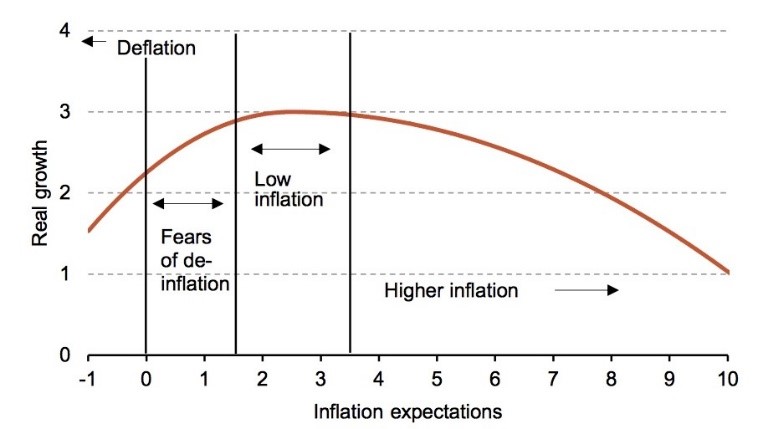
Looking at the graph, from left to right, in a deflationary environment real growth is anaemic, while moving towards the right, real growth picks up gradually with increasing inflation. This is considered a good, prosperous environment for the financial markets. Today, we here, in this low inflation environment, where real growth picks. However, anticipation of higher inflation in future is likely to create market uncertainty for future growth that will discourage investors.
Additionally, looking at the equity risk premium, the excess return of the equity market that investors require in excess of the risk-free rate, in order to invest in equities, is the lowest in low inflation environment. When inflation increases, the premium increases accordingly, and investors require better returns.
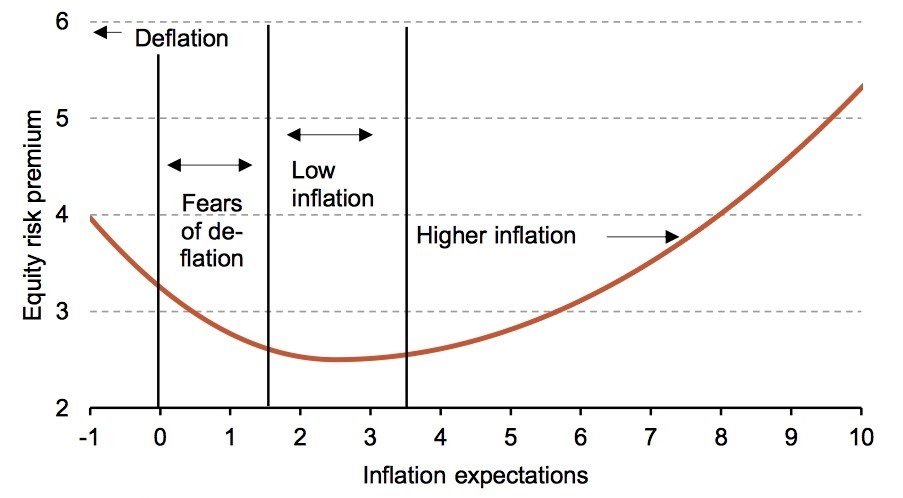
Combining these two contrary views, there is case to be made on the impact of inflation (expectations) on equities and bond yields. When interpreting these views to assess the health and the current stage of the US economy, it is rational to expect that 2.1% inflation and 2.5 % inflation expectations, within tight labour markets where unemployment is below 4%, can be considered ”good & healthy”, relative to level of equity risk premiums.
Factoring in our framework the impact of a large tax stimulus from the US government – our ideal target would be to remain in this market environment as long as possible. There are many indicators to identify risks related to inflation such as the average hourly earnings when it exceeds the threshold of 3.5%, the core personal consumption expenditure (FED’s favourite indicator) crossing the threshold of 2.5%, the five-year inflation expectations above 2.5%, and the two-year Treasury bill trading above 2.5%. Data announcements regarding these indicators are likely to move the markets. For that reason, thoroughly monitoring these indicators can give us a good understanding about the current level of inflation, as well as the turning points for the pricing of asset classes in the financial markets. Based on the performance of the financial assets, allowing inflation to slightly overheat the economy is not necessarily bad. In this environment equities outperform other asset classes, while the yield curve tends to flatten (and if there is persistently high inflation the yield curve invert).
Under those circumstances, markets are expected to be volatile and currency fluctuations are plausible to add into the investment mix. It is bold to mention that low inflation is over, however, it is very likely that inflation will gradually increase in the future. This will support equities, as it can be seen from solid earnings growth as of 15%. With major central banks and the global economy fully geared to generate inflation, the role of diversification kicks in. Investors should diversify their portfolios and reduce asset correlations significantly. It is advisable to search for yield to commodities, alternatives, hedge funds, relatively to equities and bonds.

Georgios TheocharisInvestment Strategist
Disclaimer:
This market commentary is merely for informational purposes. It should not be considered an investment proposal to buy, sell or hold securities, financial instruments or investment products. It contains opinions and views of our analysts, at the date of issue.