
It was previously considered a topic of theoretical curiosity in economics that interest rates will turn that low to constrain the ability of monetary policy to respond to negative economic shocks. This article explains the main reasons behind the downward trend of nominal interest rates into a negative territory and identifies four key transmission channels through which negative interest rates affect the overall economic activity. It also addresses possible policy implications, as well as conflicts between these four transmission channels. It calls for the coordination of the policy mix (monetary, fiscal, structural reforms) to undertake specific, tailored investments with social impact – investments that would be catalysts for growth and prosperity.
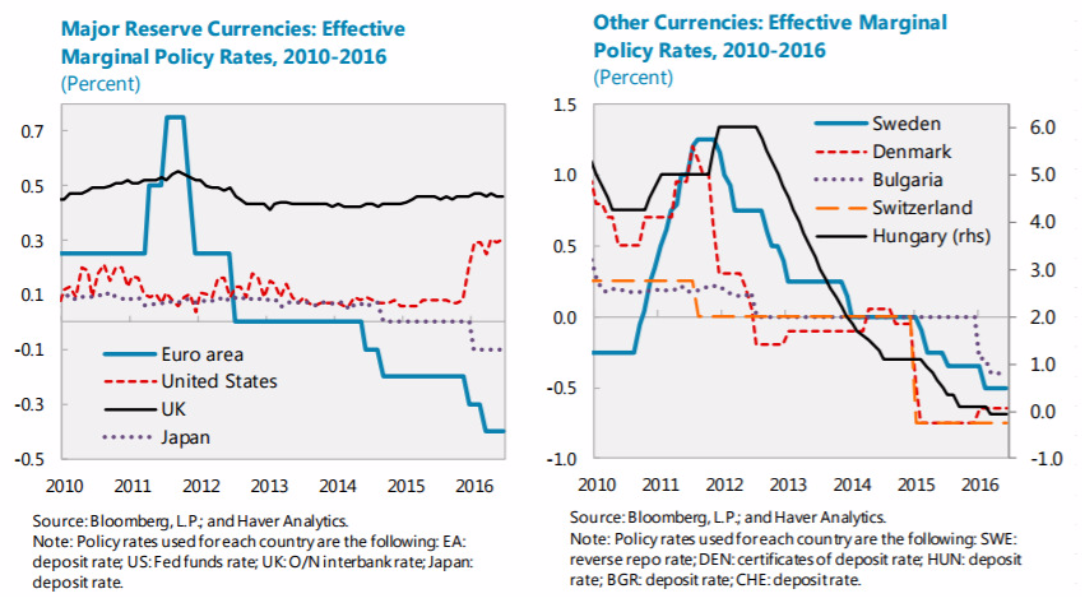
In the aftermath of the 2008 financial crisis, central banks reduced interest rates to ease lending to the economies and stimulate aggregate demand. However, if we look at the international macroeconomic picture over the last 30 years, there has been a steady decline in interest rates. For example, in the US, interest rates dropped from 19% in the early 1980s to 0.5% as of today (2016). At an aggregate level, two main factors led nominal interest rates to decline.
- The first is the decline of real interest rates (nominal interest minus expected inflation)
- The second is that inflation expectations have declined with the disinflationary policies of the 1980s and the introduction of inflation targeting policies as a monetary tool in the 1990s.
Accordingly, while markets have played an important role, nominal interest rates have come substantially to lower levels – during normal economic times – that lead us to the conclusion that other factors have likely weighted more to this downward trend. We argue that global political developments, demographic shifts, technological advancements, financial globalization, as well as the integration of China, India, Saudi Arabia, and other commodity-exporting countries to the global economy, have pushed interest rates down.
Since other roles are important for that trend, central banks have found their ability to conduct monetary policy constrained by the zero-lower bound (ZLB). This is an essential problem that limits future policy options. In other words, in the event of a future crisis or whenever unemployment exceeds a threshold, nominal interest rates will often hit zero.
As a response, to deal with the crisis and mitigate further risks, central banks rely on unconventional policies, such as, asset purchasing programs, changing inflation expectations, and negative interest rates. Negative interest rates are mainly for exchange rate considerations, as a mean to circumvent the monetary lower bound that is defined as a point of switching into cash (which has zero yield).
Central banks in Bulgaria, Denmark, ECB, Hungary, Japan, Sweden, and Switzerland have had negative interest rates. None of these countries have experienced a shift to cash – something that implies the existence of frictions near the lower bound.
Negative interest rates are still unpopular and reasonably counter-intuitive, since the average person is not familiar with the idea that lenders might be willing to pay borrowers to borrow their money.
There are certain advantages, implications and concerns regarding possible side-effects of negative rates. Briefly, there are four main channels through which negative rates affect economic activity.
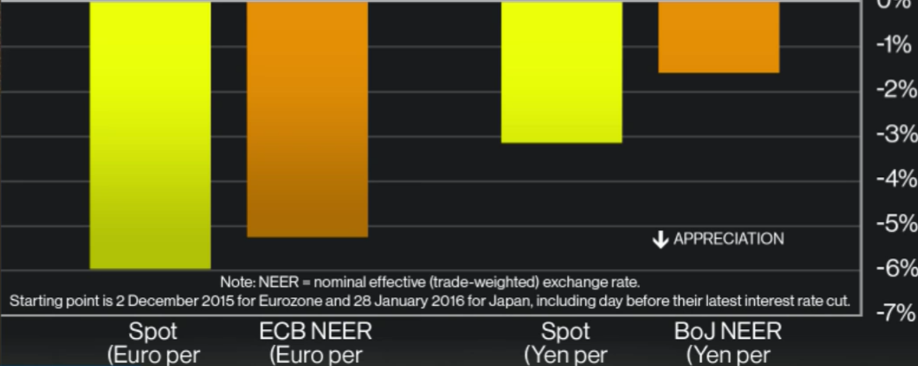
The first is the “exchange rate” channel. Cutting interest rates leads to exchange rate depreciation. It makes the domestic currency less attractive relative to other currencies, and, assuming that “appropriate conditions”[1] hold in the domestic market, negative interest rates can boost exports and improve the trade balance of the economy.
For example, the Swedish krona has been pegged to the Euro since 2002. When the credibility of this link came into question in early 2015, the Central Bank of Sweden decided to impose negative interest rates in the commercial banks to discourage speculation by decreasing capital flows into the Swedish economy.
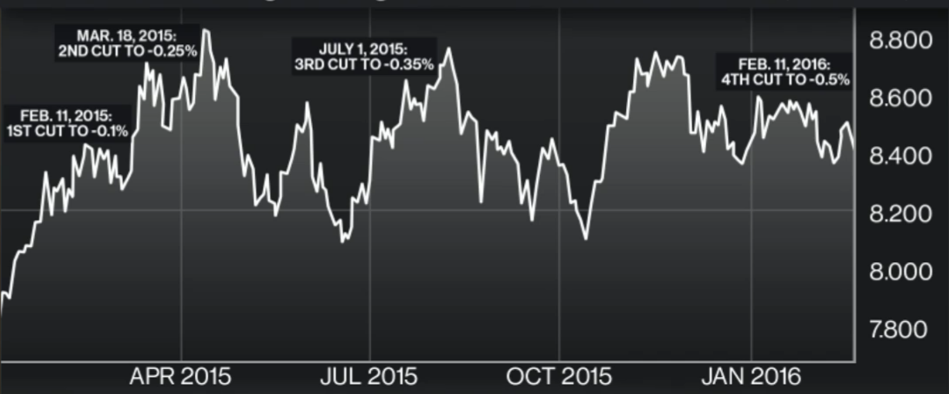
With four successive cuts, the Swedish krona weakened in the currency markets. Accordingly, there is evidence that the exchange rate channel works efficiently for small open economies like Sweden.
The first is the “exchange rate” channel. Cutting interest rates leads to exchange rate depreciation. It makes the domestic currency less attractive relative to other currencies, and, assuming that “appropriate conditions”[1] hold in the domestic market, negative interest rates can boost exports and improve the trade balance of the economy.
The second channel is through “credit creation”. Perhaps, this is the most debated channel. In general, low rates reduce the incentive to save by encouraging consumers to spend more rather than hold onto cash. Lower borrowing costs encourage consumers to take out loans to finance their consumption by increasing their debt (credit) that stimulates the economy. Specifically, when central banks cut interest rates, they induce a substitution effect, from safe assets (US Treasuries) to less safe assets (loans).
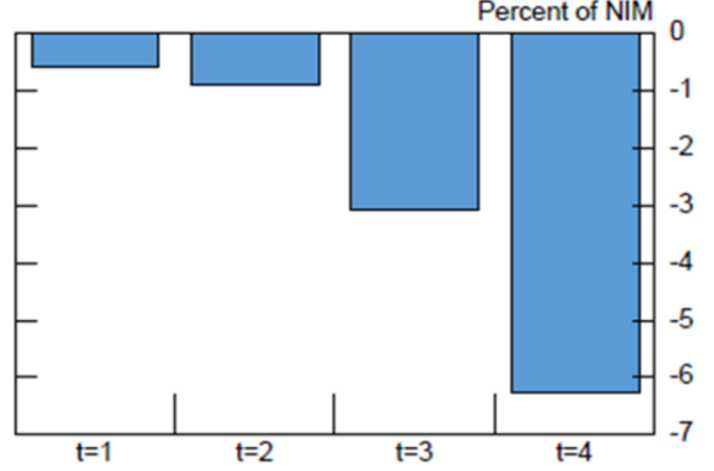
We expect the same logic to apply to negative rates. However, within an environment of sub-zero rates, there might be a point that accommodative policy reverses its effects and become contractionary (Brunnermeier, Koby 2016). In other words, there might be a point that depresses rather than stimulates lending in the economy, since negative rates can hurt the profitability of the banks and consequently reduce the total credit in the economy.
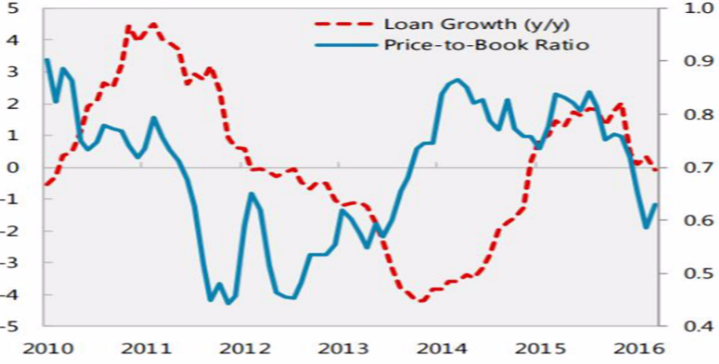
The reason is that compressing net interest margins (NIM) affects earnings, and hence, corporate profitability. Banks get less reward for lending, consequently, their incentive to lend is smaller, since every new loan shrinks their balance sheet. As a result, credit growth declines.
Supporting evidence can be found in research papers by the Bank of England (Butt et al., 2014) and the Bank of International Settlements (Borio et al., 2015) suggesting that the positive effects of low-interest rates are outweighed by the negative effects on interest income.
To maintain the credit flow, some central banks have imposed large exemptions on their reserves, between lending and deposit rates in order to prevent banks passing on negative rates to their clients. Ultimately, this can avert a cash-run. But from a balanced portfolio perspective, large exceptions don’t optimize aggregate demand.
Accordingly, the third channel is via the “wealth effect”. This channel suggests that when prices increase, the owners of the assets feel wealthier; and it is likely they spend more. In other words, monetary accommodation supports asset valuations, and higher asset prices are likely to boost spending.
On the contrary, negative interest rates might also work oppositely to the wealth effect, since they can be interpreted as a tax on the banks or a tax on savings. In both cases, there is a risk that the wealth effect will be mitigated. The fourth channel is through “financial stability”. This is focused on developing trends, analyzing the likelihood of contagion effects in the market and the possible impacts that firms pose to systemic risks. Perhaps, with sub-zero rates, there are points at which market participants will choose to hold more cash rather than assets that pay negative yields. This generates extra pressure on the financial institutions – which are already under regulatory scrutiny. Insurance companies and pension funds may run insolvency risks in the future since they might not be able to deliver expected returns to their clients.
Accordingly, the third channel is via the “wealth effect”. This channel suggests that when prices increase, the owners of the assets feel wealthier; and it is likely they spend more. In other words, monetary accommodation supports asset valuations, and higher asset prices are likely to boost spending.
On the contrary, negative interest rates might also work oppositely to the wealth effect, since they can be interpreted as a tax on the banks or a tax on savings. In both cases, there is a risk that the wealth effect will be mitigated. The fourth channel is through “financial stability”. This is focused on developing trends, analyzing the likelihood of contagion effects in the market and the possible impacts that firms pose to systemic risks. Perhaps, with sub-zero rates, there are points at which market participants will choose to hold more cash rather than assets that pay negative yields. This generates extra pressure on the financial institutions – which are already under regulatory scrutiny.
Insurance companies and pension funds may run insolvency risks in the future since they might not be able to deliver expected returns to their clients.If there is a prolonged period of negative interest rates, pension funds will probably have to change their business model and undertake more risk to stay in the market. Therefore, besides the reduction of exogenous systemic risks, there are still persistent endogenous firm-level risks that can threaten the resilience of the system.
Overall economic performance could have been better if we haven’t had the lower bound constraint, however, due to the nature of the problem central banks seem to run out of ammunition. This is signaling that monetary policy cannot be the only game in town. In the upcoming years, there may be a need for fiscal space accompanied by structural reforms to stimulate the economy.
Ultimately, any form of fiscal policy accompanied by structural reforms would be more effective at this point since it will contribute immediately to economic activity, whereas monetary policy only attempts to stimulate activity by interventions. In other words, with a targeted expansionary fiscal policy, the economic multiplier on government spending will have a significantly higher impact on productivity and output.
Central banks holding domestic public debt can be swapped into a long-term zero-coupon bond. In that way, public spending won’t be a burden, since governments will borrow cheaply to make tailored investments with social impact. Also, in political terms is more acceptable to create jobs, build new industries, and increase the living standards of the average household than focusing strictly to achieve fiscal targets.
We need to adapt to an economic environment, where problems consist of deflationary risks rather than inflationary ones, problems of insufficient demand as of inadequate supply. Thereupon, we should seize the opportunity, put our differences aside, achieve more cooperation and redirect the excessive current market liquidity to something useful for our societies. Looking at the future, monetary policy cannot absorb all the weight by itself, there must be a more balanced economic policy mix. This is not matter of political ideology, but of economic reality.

Georgios TheocharisInvestment Strategist
Disclaimer:
This market commentary is merely for informational purposes. It should not be considered an investment proposal to buy, sell or hold any security or investment product. It contains opinions and views of our analysts, at the date of issue.